

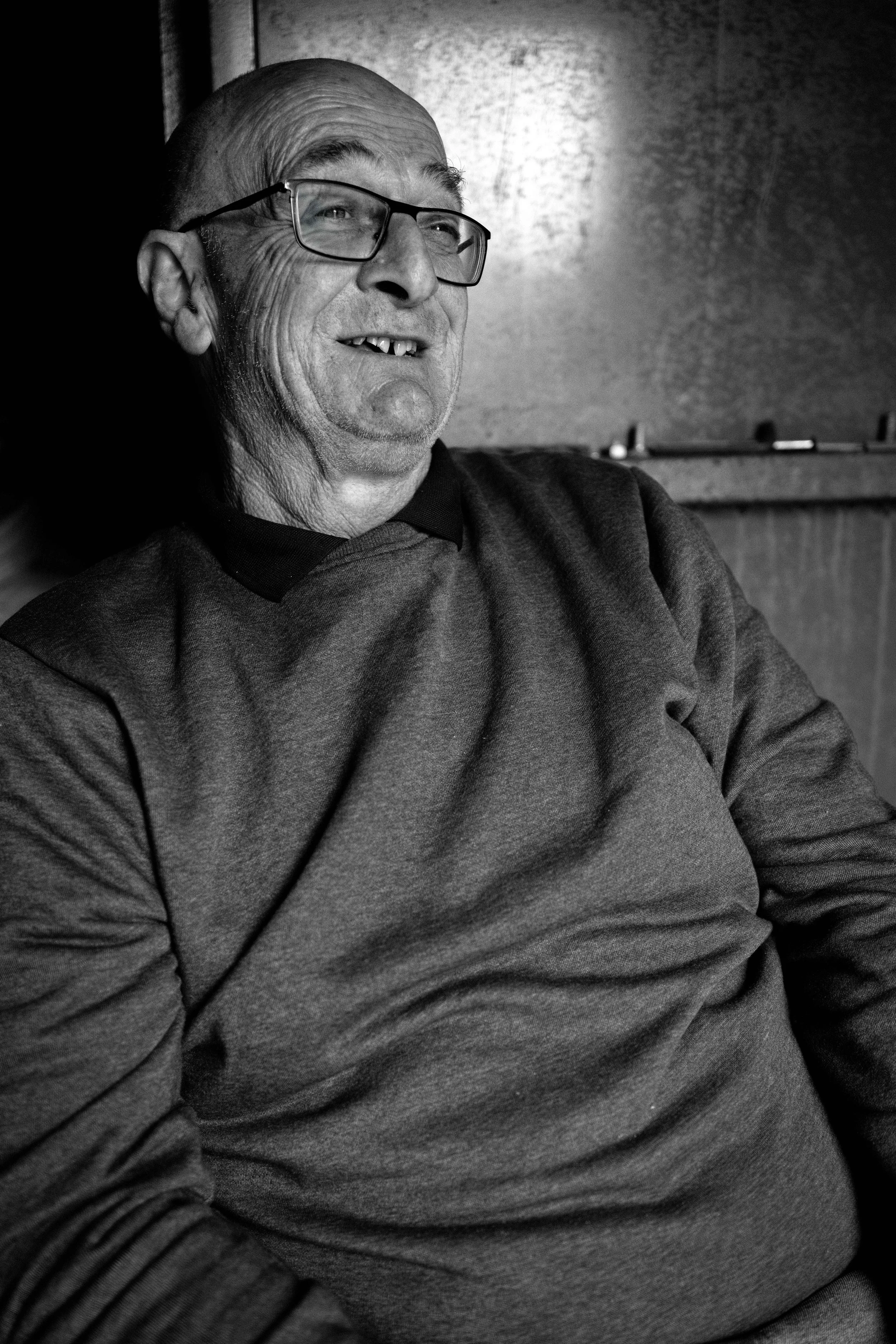
Brendan Earle in his workshop
This project continues the story that began with Our Town, a photographic exploration of Enniscorthy’s streets. Where Our Town captured the buildings across the town, this new chapter turns towards workshops, clubs, and small community spaces where life unfolds quietly but meaningfully.
Supported by Creative Places Enniscorthy in partnership with the Arts Council of Ireland, Wexford County Council, and the Wexford Arts Centre initiative, and funded through the CPE Project Award, this documentary work gives voice to those who shape the spirit of Enniscorthy every day.


A chance meeting beside the pool
I parked in the car park at the swimming pool, picked up my camera, and was about to head out towards the street to see who I could meet, and who I could talk to, about Enniscorthy now and in times past. I noticed a little work shed across the carpark with its door open. It is beside where there used to be a nightclub, Movita’s. I took a chance that there would be someone there, as the door was open and swung gently in the wind.
Who I met in there was Brian Redmond. Brian meets the morning early; the pool has people in from 6 a.m. He minds the grounds he’s looked after for “the last two, maybe two and a half years,” and steps inside when there’s a job to be done. “Some days, five schools pass through those doors. Until recently, a committee ran the place, but about six months ago the council took it over.”
He tells things straight. Next door to the pool there is a derelict site and plans have been drafted for its repurposing, but “planning surely won’t be granted.” To his eye, they’re dilapidated. He isn’t against heritage so much as he is for safety. “Buildings shouldn’t be left to fall on people. They’ve been told not to apply for planning because there are listed buildings there.”
His read on the town is the same: affectionate, exact. “Too many charity shops and cafés, and not enough places to buy what people actually need.” Gorey, he mentions, “has twenty shops that you might go into where Enniscorthy has four.”
Brian Redmond remembers a time when “you wouldn’t see the bottom of the river through all the fish”
Work here has disappeared in chunks, too. Brian spent eighteen and a half years at Wexal Aluminium out the Dublin Road, and “there was another aluminium outfit behind the post office. Those big employers are gone now. No major employers in the town anymore” he says. “No manufacturing plants taking on eighty or a hundred people at a time.”
Festivals tell a similar story. We speak about the Blackstairs Blues, the Rhythm and Roots festivals, the Rock and Food festivals, and further back to the Strawberry Fair that ran a full week, with the bandstand by the quay and events spread out across Abbey Square.
“They’re all spread out now,” he says, “over one weekend, and there’s no central point.” He remembers a time when “every man, woman, and child in the county, at some stage, would have attended the Strawberry Fair when hundreds and hundreds of people set upon the town over the week-long festivities.”
When asked about the river, he becomes the angler he’s been for roughly 50 years. “There was a two-year catch-and-release spell for salmon, but numbers are still nothing like years ago. Whatever damage is done seems to happen before the fish reach the river. Sea trout have vanished from stretches once considered the best in Europe.”
He remembers the old depth of the river. “As a young lad in a boat, there were parts where the fishing pole wouldn’t reach the bottom and we had to row across.” He now points to sections between the two bridges that are very shallow, with the water level dropping day by day. “You can walk across the river in places. Dredging used to happen the whole way down the river.” More recently, someone even offered to do the dredging and keep the gravel, but it was refused, Brian tells me.
He’s one to notice the little things too: a tree “still lodged against the old bridge from a flood that will cause bother in the next one.”

Brian sits and looks out across the Swimming Pool Car Park
Listening to Brian, I get a sense of how caretaking ranges from opening up at dawn to maintaining a town’s working memory. What has been maintained, what has slipped, what could still be saved.
His story tells me of honest work. The river and its great potential, and about the people who still open doors before the rest of us arrive. But for now, his part in this, reminds me that places don’t look after themselves. It’s the people.
A conversation with Brendan Earle
Brendan Earle’s workshop is a space where every tool has its place. Pliers, clamps, hammer, vice grips, and a dartboard on the wall. Brendan moves through it with ease, like someone who’s been fixing and making things his whole life. When he talks about horseshoes, his voice carries that same steady purpose.
“Horseshoes isn’t just a pastime” he says, It’s a way of life. Its own community. A way of measuring the years. “Few clubs are left now in the country,” Brendan informs me as we sit down for our chat. “Kildare, Donegal, Wexford, Galway. Once there were dozens or more. This was back in the early 80s.”
The decline doesn’t surprise him, but it bothers him. What used to be a local league of 40–50 players has now diminished to less than 10. He speaks to me as a past league organiser, someone who put as much time and effort into the organisation of these leagues as he did over the years into his training. “For a league to work, the plan needs to be straightforward,” he outlines. “Wednesday nights at eight o’clock, a 10-week league, insurance, registration, all sorted with a small fee to keep things covered. Only a tenner,” he says.
There’s no grandstanding about it, just the quiet certainty of a man who knows that traditions only survive if someone minds the details. He has represented Ireland 29 times all over the world, but he doesn’t linger on medals or memories. The pride is in the doing. “It’s the only sport I loved,” he tells me. And you believe it completely.

Brendan Earl shows one of his Championship winning Horseshoes
In conversation, he switches easily between the logistics of running a league and the details of his own past: how he “trained every moment” he had, how he “became the best because [he] put in the time and effort.” The only time he wasn’t training was when he “was at work, eating or asleep!” There’s humour too in his conversation, the dry kind that makes you feel like you’ve joined the club without realising it.